Why Do Dogs Need Their Tails: Key Reasons
Dogs need their tails for more than looks. A tail helps a dog communicate, keep balance during movement, and show physical and emotional signals. It also supports normal body function through bones, muscles, nerves, and blood vessels.
For dogs in the United States, tail length and shape can vary widely. Some dogs have long, feathered tails. Others have naturally short tails, curled tails, or tails shortened by docking. A dog can live without a tail, but that does not mean the tail has no purpose.
The clearest answer is this: a dog’s tail is a tool for movement and social communication, not a simple “happy flag.”

What Is a Dog’s Tail Made Of?
A dog’s tail is an extension of the spine. It contains small tail bones called caudal vertebrae, along with muscles, tendons, nerves, blood vessels, skin, and fur.
The number and shape of these bones differ by breed and by individual dog. A long tail may have more vertebrae, while a naturally short tail may have fewer. Some breeds inherit a bobtail trait caused by a genetic change, while others have a naturally curled or tightly held tail.
The tail connects to the dog’s pelvis and lower back through muscles and ligaments. Because of this connection, a tail injury can affect more than the visible end of the tail.
A dog’s tail can also vary in:
- Length
- Thickness
- Fur coverage
- Flexibility
- Resting position
- Natural curve
- Range of motion
These differences matter when reading body language. A Labrador Retriever’s tail may move in a different way from a French Bulldog’s tail, even when both dogs feel calm.
A dog’s natural tail shape should be the starting point for interpretation. Look for changes from that normal pattern rather than relying on one fixed rule.

How Dogs Use Their Tails to Communicate
Dogs use their tails as part of a full body-language system. Tail position, speed, movement, facial expression, ear position, posture, and vocal sounds all work together.
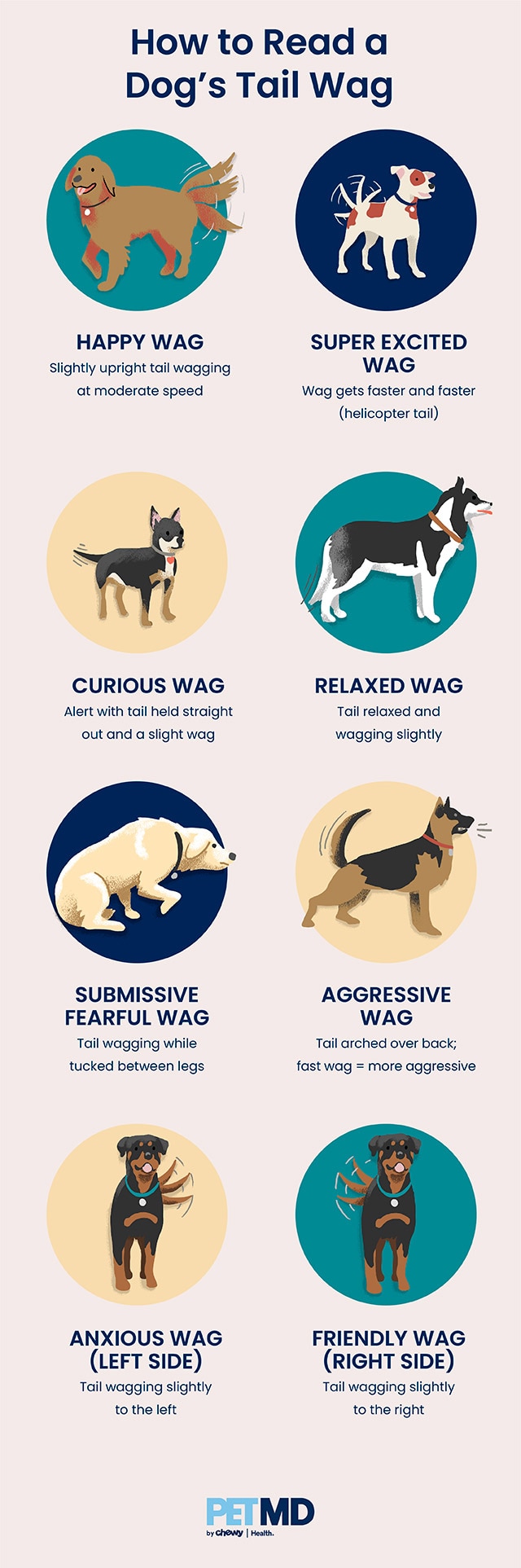
A wag does not always mean happiness. It often means that a dog is emotionally aroused or alert. The emotion may be friendly, fearful, tense, excited, or uncertain.
Common tail signals
| Tail behavior | What it may suggest | What else to check |
|---|---|---|
| Loose, sweeping wag | Comfort or friendly interest | Soft eyes, relaxed mouth, loose body |
| Fast wag with a stiff body | High arousal or tension | Staring, raised hair, closed mouth |
| Tail tucked under the body | Fear, stress, or submission | Crouching, lip licking, ears back |
| Tail held high | Confidence, alertness, or excitement | Forward posture and direct gaze |
| Slow, low wag | Uncertainty or concern | Avoidance, lowered body, yawning |
| Tail held still | Focus, caution, or discomfort | Body stiffness and direction of gaze |
| Broad “whole-body” wag | Strong excitement or social greeting | Relaxed movement and approach behavior |
These are tendencies, not exact translations. A tail held high can mean confidence in one dog and anxiety in another. Breed traits, past experiences, pain, age, and the situation all affect the signal.
A dog may wag while meeting a new person because it is excited, but the same dog may also be unsure. The safest approach is to give the dog space and watch the entire body.
Why tail movement can prevent conflict
Tail signals help dogs exchange information before they approach, play, retreat, or defend themselves. Clear body signals may help another dog understand whether an interaction is safe.
However, a dog’s tail can be hard to see. Long fur, a dark room, a curled tail, or a short tail may reduce the clarity of the signal. Dogs can still communicate through posture, scent, facial movement, vocal sounds, and physical distance.
Tail communication is useful, but it is not a complete language dictionary.

How a Tail Helps a Dog Move
A dog’s tail can help with balance and body control. It works somewhat like a counterweight when a dog turns, runs, jumps, climbs, or walks across an uneven surface.
During a sharp turn, the tail may move in the opposite direction of the body. This can help the dog control rotation and keep its center of mass in a useful position.
The tail may be especially helpful when a dog:
- Runs at high speed
- Makes a sudden turn
- Jumps over an object
- Climbs or descends
- Walks on a narrow surface
- Plays with another dog
- Changes direction during a chase
This does not mean every dog depends on its tail to the same degree. Body shape, leg strength, coordination, age, and training also affect movement.
A dog with a short or missing tail can usually walk and run. Many dogs adapt well because the nervous system learns new movement patterns. Still, a tail can provide extra control, much like a balancing pole helps a person adjust on a narrow beam.
Do dogs need tails to swim?
Some dogs use their tails while swimming. The tail can help with steering and stability, especially when the dog changes direction.
The main source of propulsion is usually the dog’s legs and body movement. A dog without a full-length tail can often swim, but swimming skill differs greatly between dogs.
Never assume a dog is safe in water because it has a tail. Dogs can tire, panic, or struggle due to body shape. Short-muzzled breeds, very young dogs, older dogs, and dogs with health problems may face added risks.
Use close supervision and a properly fitted canine life jacket when conditions call for one.

Why Do Dogs Wag Their Tails?
Dogs wag their tails because they are sending a signal and managing a state of arousal. The wag may show joy, but it can also show fear, tension, curiosity, or conflict.
Research on canine body language has found that dogs may respond differently to tail movements that lean more to one side or the other. Some studies have linked greater movement to the dog’s right side with more positive situations and greater movement to the left side with more negative or uncertain situations.
These patterns are subtle. They are not reliable enough to judge a dog from tail direction alone.
The best way to read a wag is to ask four questions:
- How high is the tail?
- Is the tail loose or stiff?
- What is the rest of the body doing?
- What is happening around the dog?
For example:
- A loose tail and loose hips often support a friendly reading.
- A stiff tail with a rigid body may signal tension.
- A tucked tail with shaking or hiding may signal fear.
- A fast wag with barking and forward movement may signal intense arousal rather than friendliness.
A wagging dog is not automatically safe to touch. Children should learn to ask before petting and to stop if the dog moves away, freezes, growls, or shows other stress signals.

Can Dogs Communicate Without Their Tails?
Yes. Dogs can communicate without tails, although the missing signal may make some interactions less clear.
Dogs also use:
- Ear position
- Head direction
- Eye contact
- Facial tension
- Mouth position
- Body height
- Weight shift
- Fur position
- Vocal sounds
- Movement speed
- Distance from another animal or person
- Scent signals
A tailless dog may rely more on its body posture, ears, face, and movement. Other dogs can learn to read these signals.
Dogs born with short tails may not face the same challenges as dogs that lose a tail later in life. A dog born with a certain body shape develops movement and communication habits around it. A sudden injury or amputation creates a different adjustment period.
Owners should avoid forcing close contact between a tailless dog and unfamiliar dogs. Slow introductions and careful supervision help both animals understand one another.

What Happens When a Dog Has a Tail Injury?
Tail injuries can be painful and may involve nerves, bones, muscles, or the spinal cord. The tail may be injured by a door, fall, bite, collision, excessive wagging against a hard surface, or being pulled.
Common signs include:
- Sudden pain when the tail is touched
- Swelling or bleeding
- A tail that hangs differently
- A bend or visible change in shape
- Trouble wagging
- Repeated licking or chewing
- Hair loss or skin wounds
- Trouble sitting or defecating
- Loss of bladder or bowel control
- Weakness in the back legs
A minor skin wound is not always minor if the tail keeps hitting objects or the injury becomes infected.
What to do
If the tail is bleeding, apply gentle pressure with clean gauze or a clean cloth while contacting a veterinarian. Do not tightly wrap the tail unless a veterinary professional has shown you how. A tight bandage can reduce blood flow.
Seek prompt veterinary care for:
- Heavy bleeding
- Severe pain
- A deep wound
- A crushed or dangling tail
- Loss of movement
- Numbness
- Trouble urinating or defecating
- Any injury near the tail base
- A bite wound
- A tail that suddenly changes position
Do not give human pain medicine unless a veterinarian specifically directs you. Drugs such as ibuprofen and acetaminophen can be dangerous for dogs.
A veterinarian may use a physical exam and, when needed, imaging to check for a fracture or nerve damage. Treatment depends on the location and severity of the injury.
Does Tail Docking Remove an Important Function?
Tail docking can remove a structure that supports communication, balance, and normal body function. The effect depends on how much of the tail is removed and the dog’s individual needs.
Some puppies are born with naturally short tails. That is different from surgically shortening a normal tail.
The American Veterinary Medical Association opposes cosmetic tail docking and ear cropping when these procedures are done solely for appearance. The organization states that such procedures are not medically indicated and can create risks related to pain, anesthesia, infection, and communication.
The American Animal Hospital Association also opposes cosmetic tail docking. Rules on docking vary across the United States, including differences among states, veterinary regulations, and breed practices.
Tail docking may be medically considered in limited cases, such as severe injury or disease. That decision should come from a licensed veterinarian who can explain the likely benefits, risks, and alternatives.
A common mistake is to treat breed tradition as proof of medical need. A long-standing practice is not automatically necessary for every dog.

How Can You Tell What Your Dog’s Tail Means?
Read the tail with the entire dog, not by itself. First, learn your dog’s normal relaxed posture. Then compare its behavior in calm, exciting, stressful, and unfamiliar settings.
Use this simple process:
- Observe from a safe distance. Do not reach toward a nervous dog.
- Check the tail’s height and curve.
- Look for stiffness or loose movement.
- Watch the ears, eyes, mouth, and body.
- Identify the trigger, such as a visitor, another dog, food, pain, or a loud sound.
- Give the dog more space if the signals conflict.
When a dog’s tail says “excited” but the body looks stiff, choose caution. When you are unsure, pause the interaction instead of testing the dog.
A certified veterinary behaviorist or qualified reward-based trainer can help when tail signals are linked to fear, aggression, or repeated conflict. A veterinarian should assess sudden changes, pain, or unusual tail carriage.

Key Takeaways
- Dogs use their tails for communication, balance, and body control.
- A wagging tail does not always mean a dog is happy.
- Tail position must be read with the dog’s posture, face, ears, and surroundings.
- Dogs can adapt to a naturally short or missing tail, but communication may be less clear.
- Tail injuries can involve bones and nerves and may need prompt veterinary care.
- Cosmetic tail docking removes a useful body part and is opposed by major veterinary organizations.
- When a dog’s behavior or tail position changes suddenly, contact a veterinarian.
Frequently Asked Questions
Do dogs feel pain in their tails?
Yes. A dog’s tail contains bones, muscles, nerves, and blood vessels, so injuries can be painful. Some tail wounds may also cause nerve problems or infection.
Why does my dog’s tail stop wagging?
A dog may stop wagging because it is focused, worried, tired, in pain, or responding to a new situation. A sudden change, especially with pain or weakness, deserves a veterinary exam.
Why does my dog chase or bite its tail?
Tail chasing can occur during play, but repeated chasing may relate to itching, allergies, parasites, pain, stress, or compulsive behavior. A veterinarian can help identify the cause.
Do puppies know how to wag their tails?
Puppies develop tail movement and social signals as they grow. Early tail movement may not carry the same clear meaning as the body language of an adult dog.
Can a dog’s tail break?
Yes. Tail bones can fracture or become dislocated. Injuries near the tail base may be more serious because nerves in that area can affect movement, urination, and bowel function.
Should I touch a dog’s tail?
Only if the dog is comfortable and the owner permits it. Avoid pulling, bending, or holding the tail. Stop if the dog stiffens, moves away, growls, or shows other signs of stress.
Conclusion
A dog’s tail is a working part of the body. It helps with balance and movement, while its position and motion provide useful social signals.
The tail is only one part of canine communication. The safest interpretation comes from watching the whole dog and respecting signs of fear, tension, pain, or uncertainty. If the tail changes suddenly or appears injured, a veterinarian should assess it.
Sources and Further Reading
- American Veterinary Medical Association: Ear Cropping and Tail Docking of Dogs
- American Animal Hospital Association: Canine Body Language
- American Kennel Club: Dog Body Language
- Siniscalchi, M. and colleagues, research on asymmetry in dog tail wagging and emotional responses, Current Biology.
- Merck Veterinary Manual: Disorders of the Tail in Dogs