Why Do Dogs Have Tails Evolution: Canine Tail Science
For dog owners in the United States, a dog’s tail may look like a simple way to show happiness. In fact, it is a complex body part that helps with movement, balance, and social signals. Dogs have tails because their ancestors inherited them from early mammals, and natural selection kept this useful structure. Later, human breeding changed tail length, shape, and carriage in many dog breeds.
The short answer: dogs have tails because tails support balance and movement and help dogs communicate. Their tails evolved from the same basic spinal structures found in other mammals, then changed as dogs adapted to different environments and human breeding goals.

What Is a Dog’s Tail?
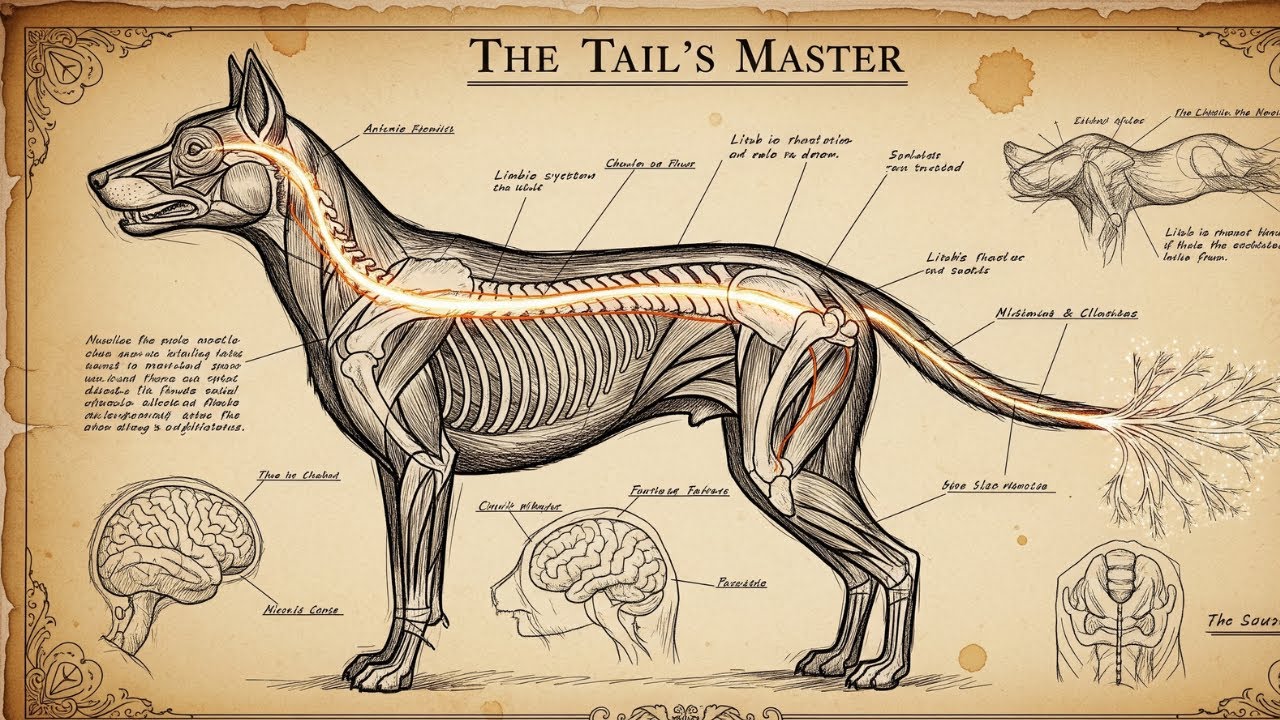
A dog’s tail is an extension of the spine. It contains small bones called caudal vertebrae, along with muscles, tendons, nerves, blood vessels, and connective tissue.
The number and shape of these bones differ among dogs. A Greyhound may have a long, thin tail. A Pug may have a short, tightly curled tail. A Corgi may have a naturally short tail or a long tail, depending on its genes and breed line.
A dog’s tail is not a “handle.” Pulling, bending, or lifting it can injure the spine, nerves, or soft tissue. The tail is part of the dog’s musculoskeletal and nervous systems.
The main parts of a dog’s tail include:
- Caudal vertebrae: Small bones that form the tail’s inner framework.
- Tail muscles: Help the dog lift, lower, curl, and move the tail.
- Nerves: Carry signals that control movement and sensation.
- Blood vessels: Supply oxygen and nutrients to the tissue.
- Skin and fur: Protect the deeper structures.
Because the tail connects to the spine, an injury near its base can be more serious than a small cut near the tip.
How Did Dog Tails Evolve?
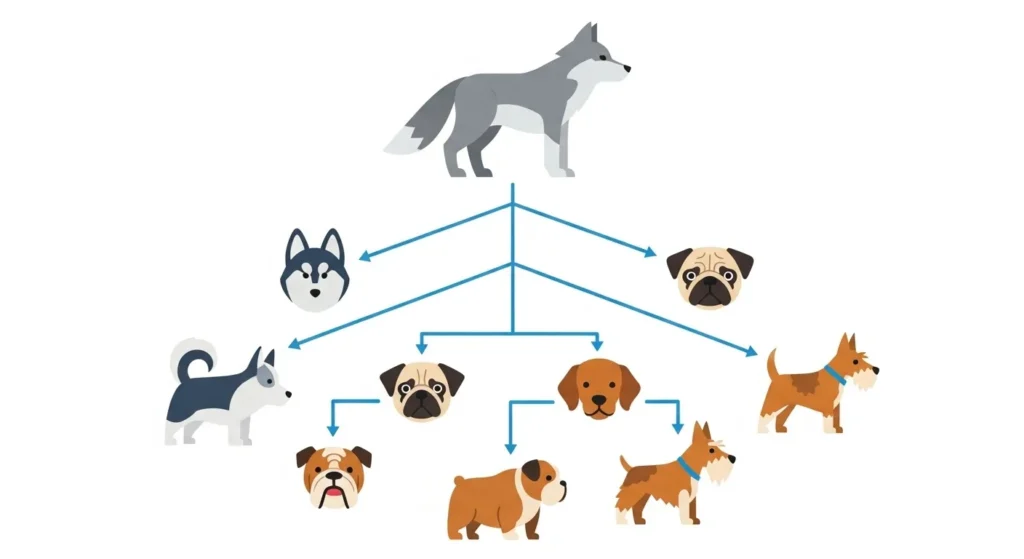
Dog tails evolved from the tails of earlier mammals. Dogs did not develop tails from scratch. They inherited a tail-bearing body plan from their ancestors, including ancient carnivores related to modern wolves, foxes, and other members of the dog family.
The first dogs were not modern pets. They were part of a long evolutionary line that included wolf-like animals. Over time, natural selection favored body traits that helped these animals run, turn, hunt, avoid danger, and interact with one another.
Later, domestication and selective breeding changed the tail in some dog populations. People selected dogs for traits such as hunting skill, herding ability, guarding behavior, appearance, and size. Tail shape became part of that process.
This explains why dogs now have many tail types, including:
- Long, straight tails
- Curved or sickle-shaped tails
- Plumed tails
- High-carried tails
- Tightly curled tails
- Naturally short or “bobbed” tails
- Screw-shaped tails
The basic tail structure is ancient. Its modern form is often the result of both evolution and human selection.
Did wolves have tails for the same reasons?
Wolves use their tails for balance and communication, much like domestic dogs. A wolf’s tail can also help other wolves read its body posture.
For example, tail position may add meaning to:
- Ear position
- Facial expression
- Body height
- Muscle tension
- Movement speed
- Vocal sounds
a raised tail may make an animal look more confident or assertive. A lowered or tucked tail may signal fear, stress, or submission. These signals are not perfectly fixed, but they can help animals avoid conflict within a social group.
Domestic dogs inherited much of this communication system. Human breeding then changed how clearly some dogs can use it. A curled tail, short tail, or heavy coat can make certain signals harder to read.
What Are the Main Functions of a Dog’s Tail?
A dog’s tail has three major functions: movement, balance, and communication. Some tails may also help with body warmth or protection, but those roles are less important in most domestic dogs.
1. Tails help dogs balance
A tail works somewhat like a counterweight. When a dog runs, jumps, climbs, or turns, the tail can help control body position.
This effect is easiest to see in fast, athletic dogs. A dog may shift its tail as it changes direction. The tail helps the body stay aligned while the legs and spine handle the main force.
The tail is not the only tool used for balance. Dogs also rely on:
- The inner ear
- Vision
- Foot and leg position
- Spinal movement
- Core muscles
- Proprioception, or awareness of body position
Still, the tail adds control during movement.
2. Tails support running and turning
A dog’s tail can act like a steering aid during fast movement. This is especially useful when the dog makes a sharp turn or moves across uneven ground.
A long tail may provide more leverage. A short tail may provide less leverage but can be useful in other ways, depending on the dog’s body shape and environment.
Different breeds show different movement styles:
- Sighthounds often have long tails that help stabilize fast running.
- Herding dogs may use the tail while making quick turns around livestock.
- Northern breeds often carry thick, curled tails that may help protect the face during rest.
- Small companion breeds may have tail shapes changed mainly by selective breeding.
These examples show that there is no single “best” tail. The useful shape depends on the dog’s body, work, and surroundings.
3. Tails help dogs communicate
Dogs use their tails as part of a larger body-language system. A wagging tail does not always mean happiness.
A tail wag may show:
- Excitement
- Friendly interest
- Uncertainty
- Fear
- Frustration
- High arousal
- Conflict or tension
To understand the signal, look at the whole dog.
A loose body, soft eyes, relaxed mouth, and broad sweeping wag often suggest friendly excitement. A stiff body, fixed stare, tight mouth, and high, rigid tail may signal tension. A tucked tail with crouched posture may suggest fear.
The speed, height, stiffness, and direction of the wag all matter.
| Tail signal | What it may suggest | Other signs to check |
|---|---|---|
| Loose, wide wag | Friendly excitement | Relaxed body and soft face |
| Fast, stiff wag | High arousal or tension | Hard stare, stiff legs, closed mouth |
| Low, slow wag | Uncertainty or concern | Crouching, lip licking, turning away |
| Tucked tail | Fear or submission | Hunched posture and avoidance |
| Raised, still tail | Alertness or confidence | Forward posture and focused attention |
| Tail held between legs | Strong fear or distress | Trembling, hiding, or escape attempts |
These are clues, not exact translations. Dogs differ by breed, personality, and past experience.
4. Tails may help with warmth
Some dogs use their tails as a source of insulation when they sleep. A thick, furry tail can cover part of the face or body in cold conditions.
This may have been useful for dogs and wild canids living in cold climates. However, a tail is not a substitute for shelter, dry bedding, or safe temperature control. A dog can still develop hypothermia or frostbite in severe cold.
5. Tails may offer limited protection
A furry tail can shield the nose or face from wind. It may also reduce heat loss when a dog curls up. This is a possible secondary benefit, not the main reason dogs have tails.
The strongest explanations for canine tails remain movement, balance, and communication.

Why Do Some Dogs Have Short or Curled Tails?
Some dogs have short or curled tails because of inherited genetic changes. In other cases, people shortened the tail through docking.
These two causes are not the same.
Naturally short tails
A naturally short tail is also called a natural bobtail. In some dogs, a change in the T gene, also known as the brachyury gene, is linked with a shortened tail.
The effect can vary. Some dogs have only a few tail vertebrae. Others have a tail that is shorter than usual but still clearly visible.
This trait appears in several breeds, including some lines of:
- Pembroke Welsh Corgis
- Australian Shepherds
- Brittanys
- Jack Russell Terriers
- Schipperkes
- Swedish Vallhunds
The exact genetic pattern depends on the breed. A genetic trait that produces a natural bobtail in one breed may not work in exactly the same way in another.
Some genetic forms of short tail also require careful breeding. In certain animals, inheriting two copies of a harmful variant can affect development. Breeders should use breed-specific genetic testing and veterinary guidance rather than assuming that every short-tail gene is harmless.
Curled tails
Curled tails developed through inherited differences in tail bones, muscles, and connective tissue. People then favored these traits in certain breeds.
A curled tail may be healthy if it is part of a breed’s normal structure. However, extreme body shapes can sometimes be linked with health problems. A tightly screwed tail may occur along with spinal or skin-fold issues in some dogs.
The tail itself should not be judged in isolation. The important question is whether the dog can move comfortably, keep the area clean, and use the tail without pain.
Docked tails
Tail docking is the surgical removal of part of a dog’s tail. It is usually done when puppies are very young, although the method and legal rules vary.
People have docked tails for several reasons over history:
- Traditional breed appearance
- Working-dog customs
- Claims about preventing injury
- Hygiene claims
- Breed standards
The evidence for routine cosmetic docking is disputed, and the procedure can cause pain and remove a useful communication tool. The American Veterinary Medical Association opposes tail docking when it is done solely for cosmetic reasons.
Rules differ across the United States. Some states restrict docking, require veterinary involvement, or regulate how it may be performed. Anyone considering docking should check current state law and speak with a licensed veterinarian. Tail docking should not be treated as a routine home procedure.

Can Dogs Communicate Without Tails?
Yes. Dogs can communicate without tails, but a missing or very short tail may remove one part of their body-language system.
Dogs also communicate through:
- Facial expressions
- Ear position
- Body posture
- Eye direction
- Movement speed
- Vocal sounds
- Scent
- Physical distance
A dog with no tail can still signal fear, play, stress, or confidence. Other dogs may rely more heavily on the remaining signals.
The problem is that a short or curled tail can make some cues harder to see. A dog may look alert even when its tail position is difficult to read. This is one reason owners should learn the entire body-language pattern rather than reading the tail alone.
Does tail wagging always mean a dog is happy?
No. Tail wagging means that the dog is emotionally aroused or engaged. The feeling may be positive, negative, or mixed.
A dog may wag while:
- Greeting a familiar person
- Waiting for food
- Facing a strange dog
- Feeling nervous
- Preparing to chase
- Showing uncertainty
A useful rule is to ask, “Is the whole body relaxed?” A loose wag with loose muscles usually means something different from a stiff wag paired with a rigid body.
Do not approach an unfamiliar dog only because its tail is moving. Ask the owner first, give the dog space, and watch for signs of discomfort.
Does the direction of a wag matter?
Research has reported that dogs may show different left-right tail movement patterns during different emotional states. Other dogs may notice these differences.
However, tail direction is not a simple code. It should not be used alone to decide whether a dog is safe or friendly. Body posture, context, distance, and the dog’s behavior matter more.

Do All Dogs Benefit From Their Tails in the Same Way?
No. Tail function depends on body shape, breed history, activity, and environment.
A long-tailed dog may gain more leverage during running and turning. A thick-tailed northern breed may gain more insulation in cold weather. A dog bred for companionship may have a tail shape selected mainly for appearance.
The tail also interacts with the rest of the body. A dog’s spine, pelvis, legs, muscles, and movement style all affect how useful the tail is.
Tail differences by body type
| Dog type | Common tail feature | Likely functional link |
|---|---|---|
| Sighthound | Long, thin tail | Balance during fast running |
| Northern breed | Thick, furry, often curled tail | Possible insulation and body protection |
| Herding breed | Moderate to long tail | Balance and movement control |
| Short-faced breed | Curled or screw tail in some lines | Selective breeding; health depends on structure |
| Natural bobtail breed | Short tail | Inherited genetic variation |
| Docked breed | Surgically shortened tail | Human practice, not natural evolution |
This table describes broad patterns. It does not predict the health or behavior of an individual dog.
Can a dog live well without a tail?
Many dogs with naturally short tails or medically necessary amputations live active lives. They can run, play, and communicate through other body signals.
A dog may need time to adjust after an injury or surgery. Balance can change, especially if the tail was long and the dog used it during fast turns. Most dogs adapt, but recovery depends on the injury, surgical site, pain control, and overall health.
Contact a veterinarian if a dog has:
- A suddenly limp tail
- Swelling or bleeding
- Pain when the tail is touched
- A tail that stays tucked for an unusual period
- Trouble urinating or defecating after a tail injury
- Weakness in the hind legs
- Repeated licking or chewing of the tail
These signs can point to nerve, bone, joint, or soft-tissue problems.

Common Myths About Dog Tail Evolution
Several simple explanations about dog tails are incomplete or misleading.
Myth 1: Dogs have tails only to show emotion
Communication is important, but it is not the only function. Tails also support movement and balance. Their structure reflects the dog’s ancestry and body mechanics.
Myth 2: Every wag means happiness
A wag shows movement and arousal, not one fixed emotion. A fearful or tense dog may also wag.
Myth 3: A dog’s tail is just fur and skin
The tail contains vertebrae, muscles, nerves, and blood vessels. Injuries can cause pain and lasting damage.
Myth 4: Short tails always come from docking
Some dogs are born with natural bobtails. Others have shortened tails because of docking, injury, or surgery.
Myth 5: Tail shape proves a dog’s personality
Tail position can offer clues, but breed, training, context, health, and individual temperament also matter. A curled tail does not automatically mean a dog is confident, and a tucked tail does not always mean aggression.
Myth 6: Tail docking cannot affect communication
Dogs have other ways to communicate, but removing part of the tail can reduce the number of visible signals. It may also affect how clearly other dogs read posture.
What Does Tail Evolution Mean for Dog Owners?
Understanding tail evolution helps owners read dogs more safely and accurately.
First, look at the entire body rather than the tail alone. A wagging tail is only one part of a dog’s behavior. Next, consider the setting. A dog at home with a trusted person may act very differently from the same dog at a busy park or veterinary clinic.
Owners should also respect tail anatomy. Do not pull a dog’s tail, lift the dog by it, or allow children to handle it roughly. Check the tail during routine grooming for cuts, swelling, mats, parasites, or changes in movement.
If the tail suddenly changes position or motion, treat that change as a health clue. A veterinarian can check for sprains, fractures, nerve injury, anal-gland problems, skin disease, or lower-back pain.
For dogs with short, curled, or missing tails, pay closer attention to posture and facial signals. Give them space when they appear stiff, fearful, or uncertain, even if the tail is wagging.

Frequently Asked Questions
Why do dogs wag their tails?
Dogs wag their tails when they are emotionally aroused or engaged. The cause may be joy, fear, curiosity, tension, frustration, or social interest. The speed, height, stiffness, and direction of the wag should be read with the dog’s full body language.
Did humans create dog tails?
No. Dogs inherited tails from earlier mammal and canid ancestors. Humans later changed tail length and shape through selective breeding and, in some cases, tail docking.
Why do some dogs have no tail?
Some dogs are born with a natural bobtail caused by inherited genetic variation. Others have a shortened tail because of docking, injury, or medical surgery.
Can a dog’s tail break?
Yes. Tail bones can fracture, and the surrounding muscles, nerves, and skin can also be damaged. A limp, swollen, painful, or bleeding tail needs veterinary evaluation.
Are curled tails harmful?
Not always. A naturally curled tail can be normal for a breed. However, very tight curls or extreme body structures may occur with spinal, skin, or movement problems in some dogs. Pain, poor mobility, repeated infections, or hygiene trouble should be checked by a veterinarian.
Can dogs understand another dog without a tail?
Yes. Dogs also read posture, ears, facial movement, scent, vocal sounds, and distance. A missing or short tail may make some signals less clear, but it does not prevent communication.
Conclusion: Why Do Dogs Have Tails?
Dogs have tails because their ancestors had tail-bearing bodies, and the structure remained useful through evolution. A dog’s tail helps with balance and movement and acts as an important social signal. Its shape may also reflect climate, work, breed history, genetic variation, and human selection.
The best way to read a dog is to view the whole animal. A wagging tail is not a promise that a dog is happy or safe. Look at the tail, ears, face, posture, movement, and situation together. If the tail changes suddenly or appears painful, ask a veterinarian for help.
Research sources
- American Veterinary Medical Association: Ear Cropping and Tail Docking of Dogs
- National Human Genome Research Institute: Dog Genome and Genetic Variation Resources
- Hytönen et al., research on the T gene and natural bobtail variation in dogs, published in PLoS Genetics
- Quaranta et al., research on tail-wagging asymmetry and canine emotional responses, published in Current Biology
- Siniscalchi et al., research on lateralized tail-wagging responses in dogs, published in Current Biology